Consulting & Implementation
Kinetic infrastructure: Implementing adaptability
Development of high-performance infrastructures designed for dynamic adaptability.
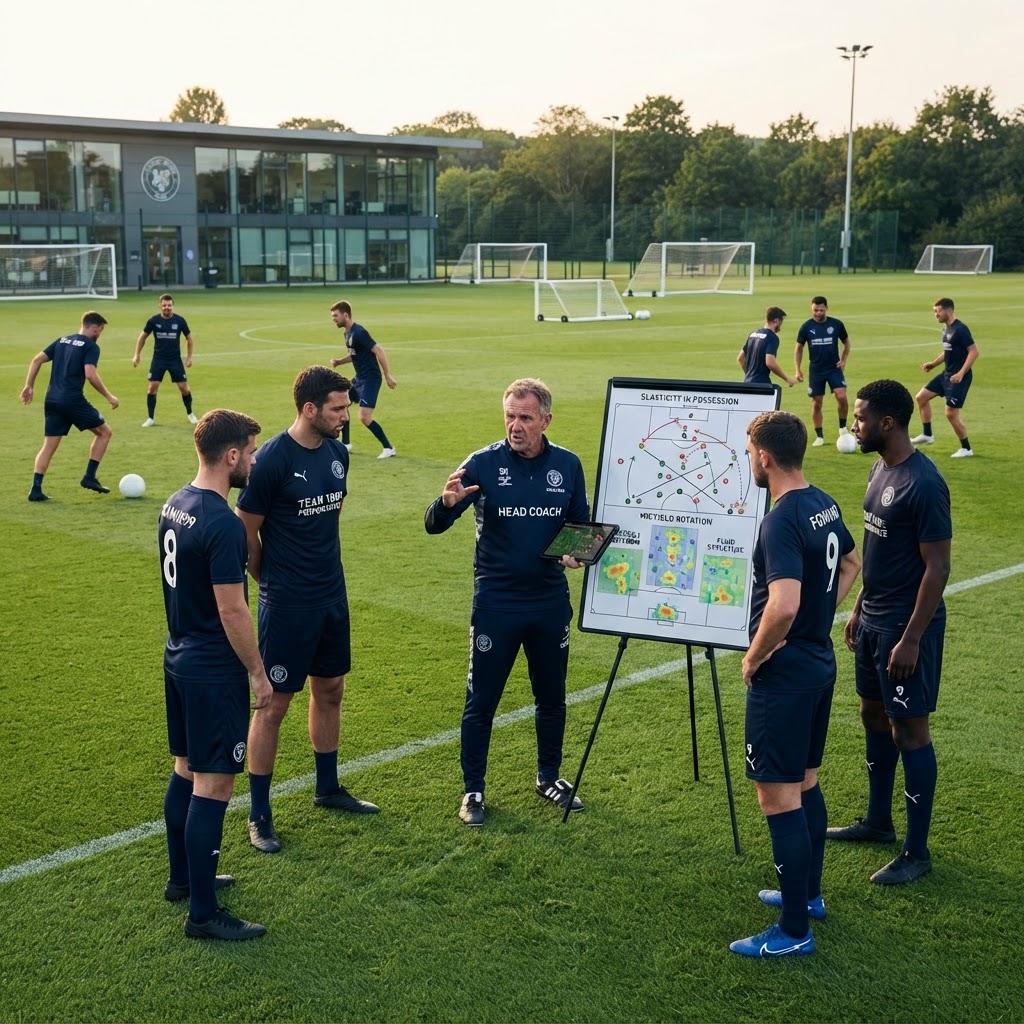
From consulting and implementation, the decisive question is how to convert the idea into governance, processes, responsibilities, and measurable operational changes within a club or federation. The fundamental error of many contemporary game models does not lie in their lack of sophistication, but in their inability to absorb the entropy of the match. We tend to design tactical structures as if the pitch were a static chessboard, where each piece must occupy a specific square. However, elite football is not a mechanical system, but a highly volatile environment. The thesis I propose is simple: a team's robustness does not come from the rigidity of its programmed movements, but from its tactical elasticity, that is, its ability to deform under pressure and recover its original shape without losing operational coherence. When a team trains under the illusion of perfect choreography, it becomes extremely vulnerable to the first unforeseen contingency. True high-performance methodology must migrate from position instruction to relationship education. Instead of teaching 'where' a player should be, we must train 'why' and 'how' their position should vary based on the opponent's behavior and the dynamics of the ball. The practical implication for a coaching staff is clear: automation tasks must be replaced by problem-solving exercises under changing constraints. If the structure does not allow for fluid adaptation without the system collapsing, it is not architecture, it is a tactical prison. Operational excellence is measured by the players' ability to make correct decisions when the initial plan has become obsolete. To visualize this, imagine a kinetic architecture structure: a network of tense cables where, upon removing one, the rest of the network automatically readjusts its tension to maintain balance, instead of a rigid structure that fractures when a single pillar is removed. Training under this premise transforms the uncertainty of the game into a competitive asset, allowing the team to be stronger precisely at the moment when chaos seems to prevail. Consulting only creates lasting value when the organization can continue to use the system after the consultant leaves.
Continue learning through the most relevant PONS route